


Welcome to Institutions.
I love reading transcripts and oral histories. There’s something timeless about hearing someone’s voice in your head, and for a moment, feeling like you’re there in conversation with them. They humanize. They reveal not just ideas, but the stories and turns that shaped them.
Most interviews we see today are podcasts or panel clips. They give us voices, but rarely images, rarely the feeling of flipping through someone’s notes, annotated with the stray thoughts and questions that make research so alive.
My hope with this series is to bridge readers to program directors, funders, builders — most importantly, people — to ask what lessons we can draw about where research is headed.
Brian Wang is our first guest.
Logbook | Dossier | Institutions

Brian Wang is the Program Director for ARIA’s Sculpting Innate Immunity opportunity space. Trained in organic chemistry at Berkeley and synthetic biology at MIT, he moved into pandemic preparedness during COVID — leading R&D at Alvea and later co-founding Panoplia Laboratories — before joining ARIA. His work is a case study in how researchers can pivot across fields and institutions to tackle urgent problems.
ARIA, the Advanced Research and Invention Agency, is the UK’s new experiment in high-risk, high-reward research. Modeled in part on America’s DARPA for high-risk, high-reward science, ARIA funds bold bets that might not find a home in academia or industry. The Sculpting Innate Immunity opportunity space is one of its earliest and most distinctive efforts: rather than chasing new antibodies, it asks how we can mobilize the body’s first line of defense.
By the time you’re reading this, Brian and his team will have launched a new thesis nested within the opportunity space — Sustained Viral Resilience — expanding the scope of innate immunity’s long-term pandemic preparedness. The team is looking for a Technical Specialist to help execute the new programme - apply here.
I spoke with Brian about his career pivots, how he selects problems worth betting on, and how he sees the future of research careers. He was candid, generous, and deeply thoughtful about what it takes to build new scientific institutions.
Thank you, Brian.
First thing I wanted to open with, in the spirit of cinematicism: if your career, or your path right now, was a movie trailer or a book, what would the tagline be?
What would the tagline be? If my career was a movie trailer. Wow. Let's see. There's been a lot of twists and turns, or at least a few twists and turns. It's been like a combination of scripted and unscripted, a combination of intentional and opportunistic. So I guess it would be, I don't know, something about following an adventure and just seeing where it goes with some organized chaos.
It gives me Paddington vibes.
I was looking at the website for Sculpting Innate Immunity - I love the way you've designed it, with annotations and how accessible it feels. I love how concrete, yet digestible it is. In your own words, how would you describe Sculpting Innate Immunity to someone hearing it for the first time? How do you summarize the idea to someone who might not be an immunologist?
You actually have two immune systems - one of them is the adaptive immune system, and the other is the innate immune system.
For most of the history of immunology, and in translating that to therapeutics and vaccines, we focused on just the adaptive part of the immune system, which is really powerful. It’s what everybody thinks about when they think about the immune system.
They think about antibodies, they think about T cells, they think about B cells, and the innate immune system is always taken for granted. This is a system that's always just there and it's humming along, it's doing its thing. It's usually hard to mess with without causing more damage than benefit.
The Sculpting Innate Immunity opportunity space is really asking this: we've had a lot of advances in our understanding of the innate immune system. We've had a lot of advances in our ability to modulate biological systems generally. It feels like now is the right time to be able to combine those together and start asking, okay, what are the actual opportunities here?
When we look at some of the greatest health challenges that we face, many of them do seem to have features that, if we could turn the knobs, we'd be able to make a big dent into those problems: chronic inflammation being one of them, underlying so many different diseases, cancer, obesity, neurodegenerative disease, and many others.
But then also, when it comes to infectious disease, some of the biggest challenges are rapidly mutating or pandemic viruses. When it comes to the innate immune system having the ability to provide broad spectrum protection, that's also a function that we might be able to take advantage of.
So we have this tool that hasn't been fully leveraged yet. How could we use these new advances in different technologies and disciplines to start leveraging that more, especially when it feels like it maps onto the biggest health challenges of today?
Makes sense. You're right that vaccines and antibodies get the big headlines. But you've gone against the norm: you've made a bet on the quieter little brother of the two immune systems. What made you believe that this was the next frontier?
This goes into my background - I was first hooked by the adaptive immune system. Actually, before my postdoc I was doing organic chemistry, that was my PhD, and I wanted to transition into something that was a little bit more translational. So I did a postdoc in synthetic biology at MIT. That started in January of 2020 - and other things also started during that time!
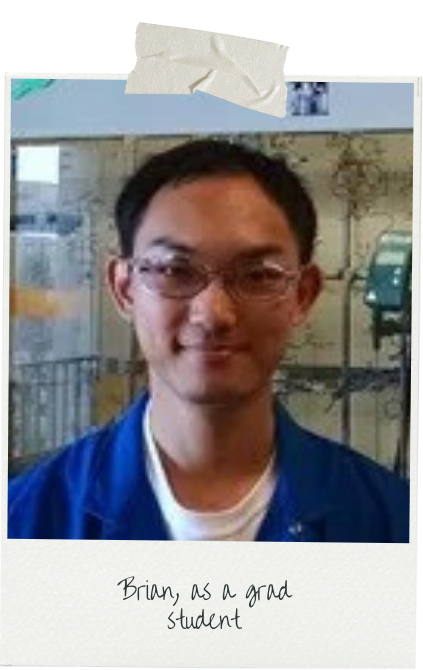
I ended up being really fascinated by the challenge of COVID-19: the story of all these scientists coming together and trying to find solutions. I was following every single preprint on COVID-19, and one thing that was clear was that a lot of the different solutions we were trying were adaptive immunity focused. The first medicines against COVID-19 that were highly effective were these monoclonal antibodies that, in October or November of 2020, got emergency use authorization.
Then of course came the first vaccines in December [of 2020]. These were not standard monoclonal antibody discovery processes. They were not standard vaccine discovery processes. These were applying the latest tools and technologies, and it seemed to me that there was a big opportunity to take all of that energy and excitement as a template for what could be done on the innate immune side.
Because really, when it comes to our body's natural defenses, it is a two-pronged system.
You have the adaptive, and you have the innate immune system, and they act in tandem, one at the early stages and one at the later stages. And so that really maps onto the same challenge that we face for pandemics as well.
Then my career took a turn from there, with ARIA being the latest iteration of that.
A lot of researchers, especially after what happened with the funding cuts in 2025, feel stuck in research.
I’m wondering: what did 2020, postdoc-era Brian, think he was going to end up, and how has that changed? Second, what kind of gave you the confidence to step sideways into, I guess not just the new domain from organic chemistry, but to feel like ARIA was the right place to mobilize that bet?
2020 postdoc Brian had some…vague ideas about what he wanted to do after a postdoc, maybe go into academia, maybe start a professorship. But I didn't have a strong conviction about what that thing I was going to try to do was. I was thinking about ideas that kind of merged my organic chemistry background with the synthetic biology that I was doing.
I was working on directed evolution. I was like, maybe you could do directed evolution of biosynthetic pathways to find new small molecule drugs, something like that. But I didn't have a strong conviction behind it. So I was thinking, okay, maybe by default that's the option.
And then this is where my career, as I started by saying, was a combination between intentional and unintentional, or intentional and opportunistic. This is where the opportunistic part came in because somebody that I was collaborating with during my postdoc during the COVID-19 pandemic called me up and said –“Hey, we work together well, and we want to start a vaccine company.”
This is at the time when Omicron was first emerging as a variant of concern. It seemed to be the case that this was a variant that was not going to be impacted by the vaccines at the time, and was more transmissible, more immune, more invasive than anything else we had seen before.
It seemed like there needed to be some sort of effort to develop a new vaccine. He, at the time, was like - why not us? And he wanted to start a company around that. He recruited me at the time when entrepreneurship was not in my vocabulary at all. I didn't even really understand what entrepreneurship was and that it was an option.
But when presented the opportunity, it seemed like a once in a lifetime opportunity that I couldn't turn down. At the time I thought it was just a short-term kind of thing! It was like, okay, I'll do this for a few months and then go back.
But ultimately, I was bitten by the bug, the entrepreneurship bug, and ended up staying long term. I left my postdoc to join that startup.
When it comes to ARIA specifically, I think there's a longer history here, of having followed some of the other ARPA agencies; DARPA, ARPA-H.
There's a thread throughout my career of always looking at what assumptions we have of how you do things, in science as well as in funding. And then I think, okay, how do we do one better? How do we advance that a little bit further?
When it comes to these ARPA-like agencies, your job as a program director is to identify those opportunities to take things one step further. So when ARIA ended up putting out a call for program directors, it was also the right timing for me in terms of the startup that I was leading at the time.
The work that we were doing, we felt like there was so much more potential than what we could fulfill ourselves as a single startup. We were working on a similar concept of sculpting innate immunity for pandemic preparedness. Right time, right opportunity.
I ended up being really excited and applying. And the fact that it was in the UK, it's a plus to be in a different location for me, more of an adventure.
The story reminds me of the Herb Boyer [Genentech] story of, here's an academic who has been here for 10, 20 years, didn’t think they’d touch entrepreneurship. How do you get researchers to step out of that comfort of academia and realize that paradigms of research, and ways of funding, are shifting? And to take on that risk?
For a lot of academics, it's from high school to undergrad to a masters to a PhD. It’s a very charted path. But it's always the people who are willing to see beyond that and take those risks that turn into the next Genentech.
I’d like to get your thoughts on problem selection and research taste becoming more important as AI becomes prominent. As a program director, how do you develop that taste, that judgment of what to pick, what not to pick, what holds promise and what's shiny object syndrome? Do you think this is something that you can train or is it just, well, innate?
It’s difficult. The way I think about it is there are two different sides of a spectrum and you kind of want to be somewhere in between, or have both sides of the spectrum in mind.
One side of the spectrum is that you're very focused on a particular problem in the lab. And that's your entire focus. Solve this particular problem in the field.
And then the other side of the spectrum is, you have a very zoomed out view about problems in the world, like how pandemics are a problem, and not necessarily having the nitty gritty ‘here's how individual solutions might play out’ to that problem.
I think that is the key to having taste essentially, is that you have both the wider lens to understand that, yes, ‘I'm tackling a really big societal challenge.’ And yet you also have the zoomed-in lens of, ‘these are potential solutions to that challenge.’
Maybe you've worked on those potential solutions yourself and you understand how they fit into the wider picture compared to other solutions that are often used for that challenge. For example, I think there is a connection here honestly, to how we think about opportunity spaces at ARIA as well.
There’s many funding calls that are on one side of the spectrum where they push funding, where they fund a particular discipline, grants for molecular biology or something like that. And then there's other funding calls that are pull funding.
So they might say, we want solutions to pandemic preparedness. We're pretty technology agnostic. But then there's, the way that we have our opportunity spaces that are in the middle where it's, okay, Sculpting Innate Immunity is, in some ways, push funding in the sense that we have a particular tool that we're trying to use, which is the innate immune system, or being able to modulate the innate immune system.
And it's also pull funding in the way that we see a lot of different opportunities with a lot of different societal health challenges that could be addressed with this tool, but it's really combining those two together, seeing the challenges and also connecting them to a technological solution – or a class of technological solutions.
That's the way we see things. On either end of the spectrum, there are big downsides. Trying to find that middle ground is where that sweet spot is, for having taste.
Are there any specific guiding questions that you ask yourself - or your team - to test whether the problem area is big enough, or risky enough?
It’s a very good question. The process is not just me asking myself, or me asking the team. It’s a very active process in terms of how we define our opportunity spaces.
We go out into the community, we do what we call discovery, and we ask some of these questions to the community: what are the biggest challenges that you're facing as a researcher? What are the biggest challenges in your field? And what are some of the opportunities that you see?
What are the things that, if X was true, would make your life so much easier? It really is an iterative process: going out into the community, going back, processing all of that information.
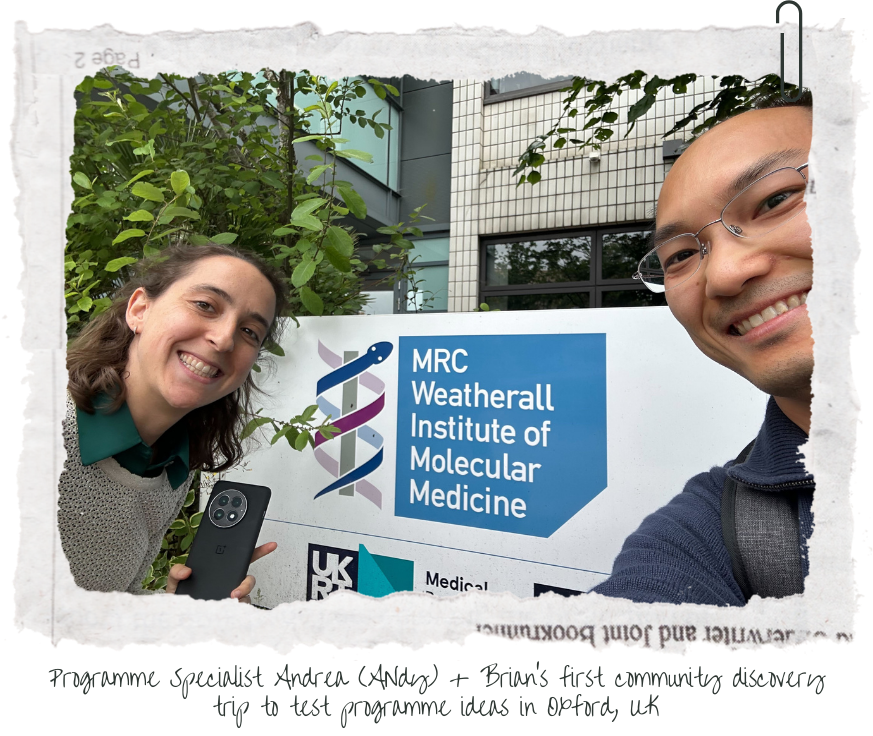
I’m sure sometimes, it's a case of: are we the right fit? There’s a problem, but we don't have a technological solution, how do we work around that? Or maybe the solution is just not legible to us.
There are certainly some guiding parameters here. One thing that we ask is: is there a potential trillion-dollar industry that could be created from solving this particular problem or finding a unique way to solve this problem?
If you think through – what is a trillion dollars? A trillion dollars is a lot! It's not something where you can casually say ‘oh yeah, maybe we can create a trillion.’ You actually have to think very carefully about this.
Obviously, that's just pure size. I would also say that, going back again to this combination of push and pull, there are some problems that are really big, but it didn't feel like it, and so this kind of goes to some other opportunity spaces that me and my team were considering at some point.
There are problems that are really big. Pandemic preparedness. Day zero antivirals. Antivirals, from day one of a pandemic, are a really important problem, but doesn't have that push component – we don’t always have the technological component of it.
And so those options fell a little bit more to the wayside compared to what we have now with Sculpting Innate Immunity.
At the stage that you’re evaluating, everything is quite early, I’m assuming. How do you distinguish between good risk, there are some danger zones that we're willing to teeter into, they're uncertain, but they could be revolutionary, versus the bad risk: they look very promising, but it might lead us to a dead end. Are those clear to you?
One thing that we certainly pay attention to when evaluating potentially risky projects is who the people behind it are. Often we say ‘people, then projects’ at ARIA.
If you have a very technologically risky project, but you have a team you meet face to face and they're so determined to get this working, and they have really strong conviction behind the proposal - versus another team that doesn't seem to understand the risks or, isn't committed to achieving things quickly…
It cannot be overstated as a factor that we take into account the people behind the proposal. I suppose when it comes to the proposals themselves, we do keep in mind that because of the gap in the funding ecosystem we're trying to fill, success is not always going to be the case.
And maybe it shouldn't always be the case, that by the end of the program, we'll have achieved some world changing impact in and of itself. So it's not going to be the case that every single project that we fund is going to contribute to that world changing impact by itself.
For this opportunity space it's about drug development or vaccine development. And so, if a project gets to some sort of proof of concept, okay, that proof of concept is not a drug by itself. It's not on the shelf; it's not helping patients by itself. But if we go 10 years in the future, 20 years in the future, and then look back and say, ‘was that a valuable part of the ecosystem that allowed these drugs to be on the shelves in 20 years?’ Then yes, that's a bet worth taking.
I’m looking at it from a whole portfolio approach of, okay, what are the technologies that we would've wanted to see in the pipeline now if we were imagining the success in 20 years’ time?
That's awesome. This reminds me of Don Braben's approach. I don't know if you're familiar with him, he did the venture research program with BP (British Petroleum) back in the 80s and 90s, and he takes the same playbook as you. Most of these projects might not work! And in fact, if most of your projects end up working out, you're not actually taking enough risk.
Obviously, that was a very different time. But while we’re at it, to pull from some fun historic precedents here, do you have any thinkers or institutions that you take precedent from in designing your own program?
There’s a very clear example here. One of the biggest wins in pandemic preparedness, came from DARPA funding the RNA vaccine work early on. So that's Dan Wattendorf as the DARPA program manager.
This is something I think a lot about for my own program. For Dan’s program, I didn’t think it was necessarily the case that people would see it as a success in 2020. It could have been not until 2030, or 2035, or even way down the line.
It just so happened that the pandemic happened in 2020. That links back to what we’re talking about with project success. Or asking ourselves what kinds of projects we take a bet on.
There’s an acceptance, sometimes, of, okay, this is a project that's going to lay dormant for some time because maybe the conditions just aren't right. But in 10 years that can change.
It can be a little bit constraining or stifling to innovation if you require all projects to have an immediate like path to clinic, which is not even on the shelves to patients yet. There’s so many parameters you have to get right in terms of manufacturing costs, in terms of IP, and in terms of, a good market and everything there.
And some of those things are very contingent on the time that we find ourselves in and acknowledging that now may not be the right time. But if the technology is sound and, in a place, where the other things line up, then that technology can be taken forward.
You've mentioned a couple times now that one of the biggest constraints is probably the technology that enables that. I'm wondering, what are signals that we should be looking for that the technology is ripe and ready?
I've always thought about biology specifically two prongs: the people who do the lab work, the research, and then the technologists who enable them to actually do that research. Is there an interest in this opportunity space to back that second group of people, or is that out of scope for you?
So this is something that's very relevant. We have a new thesis that will be launched by the time people see this interview live, or it might be on the same day. It’s called Sustained Viral Resilience within the Sculpting Innate Immunity opportunity space.
We have this individual program within that space. The goal of that is to develop these innate vaccines, vaccines that work by stimulating or augmenting the innate immune system, modulating the innate immune system in some way to provide months-long prophylactic protection against many different viruses simultaneously.
And within that opportunity space’s structure, we recognize these different roles that are played within a healthy ecosystem, including people that are testing vaccine candidates themselves and iterating what works and what doesn't work.
That’s a very important part of the ecosystem. But then you also have the technology developers, the people that are developing shared platforms, tools resources as well, that need support. And so we have separate tracks of funding for those within this opportunity space, at least as we currently conceive it.
Since we’re talking about ecosystems: I’ve already asked you who you look up to in institutions and researchers…I'm wondering if there's anybody or anything, maybe in an adjacent domain or something left field, that you also draw inspiration from.
I don't know how adjacent or left field this is, but I do take inspiration from people who seem to have a lot of drive for a particular mission and persist, beyond when a sane person would persist.
In the biological sciences, this is Katalin Karikó with mRNA and struggling with so many rejected papers and grants and even lack of respect from her peers - then finally being validated years and years later after the original research was done.
I do think about people in the technology sector as well. I've read biographies of Steve Jobs and Elon Musk, and seeing how they persisted in their early days, and all the failures…it’s something I think about whenever I'm having a little bit of a rough time.
The kinds of things that people put themselves through, and the kinds of things that people can persevere through when their backs are against the wall…I guess this is more left field, I think soldiers in the trenches for World War I.
You hear about some of the conditions there – I’m reminded of the limits of what a human being can endure. There’s always more than you even think is possible out of yourself to accomplish.
I love the Karikó example. That was actually one of the first stories that pushed me to not do my PhD. And then the other analogue to that is Carol Greider. Her NIH grant got rejected the same day she won the Nobel. All this to say there are notorious problems in research.
I'm wondering how you think the field of research itself is going to evolve over time. Back in the day, for example, it seemed like people were much more willing to work on hard problems for longer, and I'm not sure if that's just the nature of who was able to be a researcher, the kinds of people who were funded, who were in positions of power. How do you think research is going to evolve, in the next one or two generations?
One place to start - I'm from the US, and viewing the current funding climate there, I think we’re going to get much less public funding. We’ve already seen the cancellation of many grants for RNA research, that’s close to my field. People will have to turn to some alternative means of getting funding and even thinking about their science because of the climate shift.
But even before the last couple of years, there was a pressure buildup; it was just harder and harder for especially early career researchers to their first R01s. [note: the R01 is the NIH’s grant for independent research projects. As of 2025, the average age at first R01 is near 50.]
When everybody's struggling to get public funds, people are going to look around and, say, okay, who else? Who else is going to step in and fill in the gaps? And what does it mean for our science? What does it mean when, instead of a peer review panel, it's a different set of people looking at our science? How do we think about that science differently as a result?
So I think some of it is going to come from that circumstance of lower amounts of public funding. Maybe there’s a potential silver lining to all that.
What I'm hearing then is, young researchers should apply to ARIA.
They should!
This is just relevant because, even just from observing my cohort, a lot of young people have elected not to pursue academia. You've got organizations like ARIA who come in and patch parts of that pipeline.
But I think it's safe to say that when you were doing your PhD it was a different environment. In 2025, if you were wrapping up your PhD, or in the middle of it, what signals do you think young people should look for to decide whether they should stay in academia, apply to grant programs like this, or pivot their research? What would you be more attentive to if you were, say, 25 [years old] and still in school, wanting to do research in some capacity?
So I think there's some positive signals and some negative signals that might shift you one way or the other.
I mentioned earlier that postdoc Brian had some conception of going on to academia, but didn't have strong conviction behind the specific ideas. That's a very important signal to pay attention to if that's also the case that you're in. You might want to follow the default path, but the default path doesn't map onto the research that you want to do. Certainly pay attention to those signals.
I think on the positive side, and again, this is drawing from the way that my career has gone in, pay attention to if you are doing the research that you want to be doing, or if you see where research that you want to be doing is being done.
Entrench yourself in those communities. They may be non-traditional communities. Find the people that seem to be thinking like you and seem to be tackling the same problems that you want to be tackling. They’re not always going to be in your institution. They're not always going to be in your lab.
I mentioned this collaborator earlier, right? The one I ended up going off on the startup adventure together with. That happened in some ways because we were part of that same community to begin with.
Find those people, wherever they are, and paths will open up. And then when they do, pay attention to those.
You look so happy talking about it. I’m a fan of seeing how network effects and butterfly effects play out.
Is there one moment that you can think of that seemed minor at the time, but ended up changing the way you think, the path that you went down?
One comes to mind. In my PhD, this is like 2017, 2018, something like that – and I don't know if you'll believe me when I say this - but I was thinking: pandemics are a potentially really big problem, right?
Oh, I had no idea!
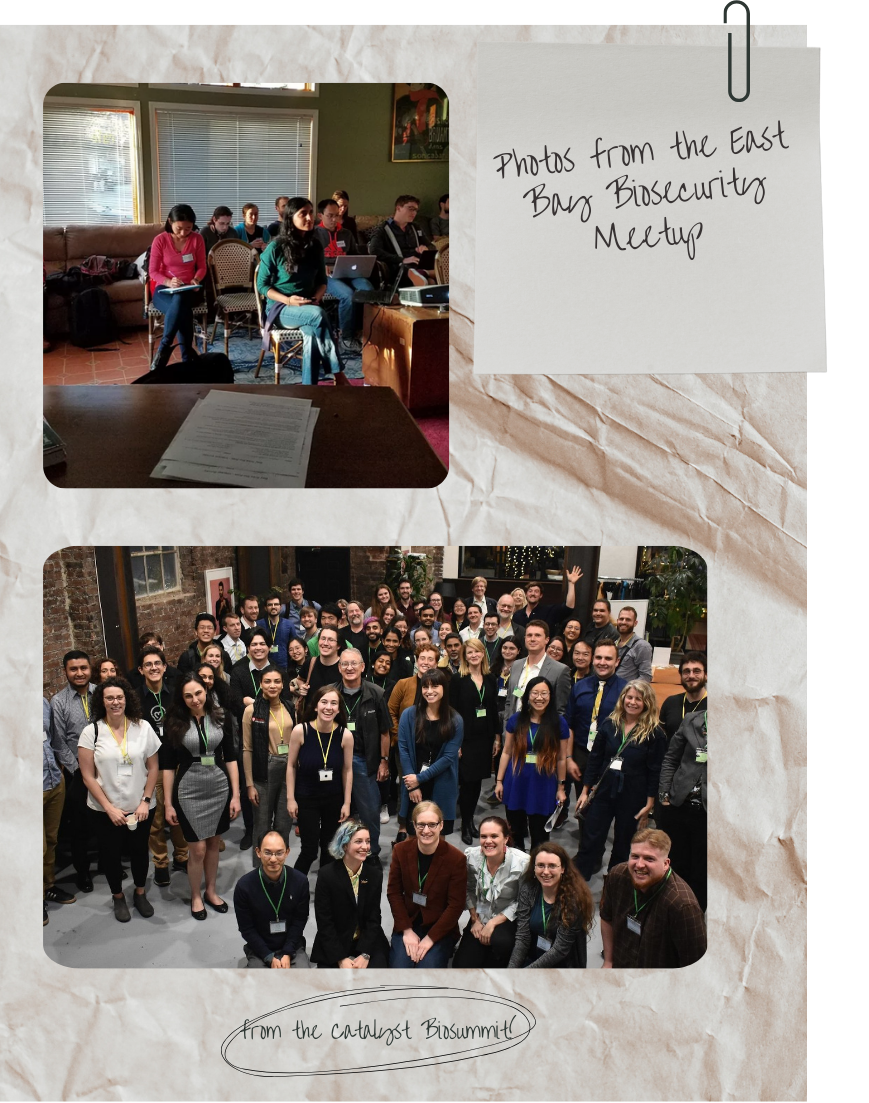
I heard some murmurs of people starting a biosecurity group. I think I saw maybe a video online or something. This person, Anjali, who was a PhD student at Berkeley at the time, I reached out to her and said, ‘Hey, I've heard some things about a biosecurity meet, I'd love to be involved.’
I'd never met her before. She didn't know who I was. And we just met up and had a coffee and she connected me to a few other people as well that were thinking about this. And then we formed the group – we called it the East Bay Biosecurity Meetup.
And we just started talking once every two weeks, and having readings, discussion sessions, presentations, going off to events sometimes. And that really opened my eyes up to this – it’s what led me to apply to the postdoc and synthetic biology. It exposed me to all these different medicines that were being used for pandemics, some of which were more chemistry based, and some of which more biology based.
Shout out to Anjali for being willing to have that initial conversation that got me to where I am today.
The next question is the last one I’ll throw to you. You’re the first guest in this series, so you have the very big and weighty task of keeping this series alive.
Oh, wow, okay.
What is one question that you'd like me to pass forward to our next guest? Someone who's also a program director, funder, organizational thinker, in some way restructuring the way we do research. Is there any one burning question you want to ask?
That’s a good question. I’m at ARIA because I want to iterate on different models of funding. At ARIA, we think of ourselves as iterating on the ARPA model, but there’s many different ARPAs and we're always trying new things as a relatively new organization.
I'd ask them, in terms of how they think, not necessarily just research-wise or scientifically, how what they're doing might serve as an example of something new, structurally.
Very applicable question, very relevant. That’s all I’ve got for you today – I want to give a huge shout out to you, thank you so much for taking the time. I hope you take great pride in being our number one guest here!
I'm honored.
Further Reading & Links
Congratulations on the new series launch!
Wow, this was a great read. Keep this up - there’s lots of wisdoms for people doing the research and backing the research.