


Logbook | Dossier | Institutions

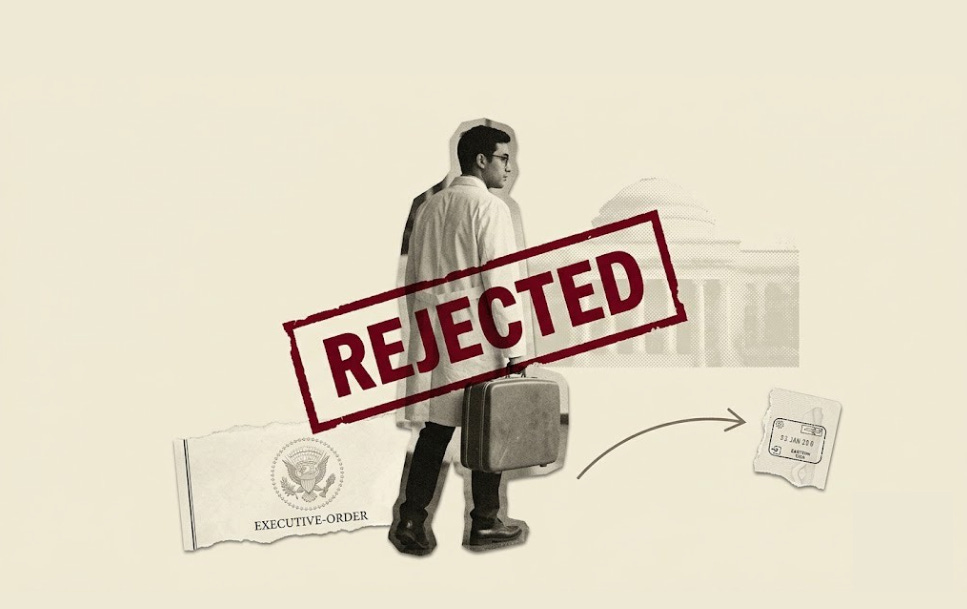
12 hours before Trump dropped his new H-1B executive order, I was watching Michio Kaku’s 2018 talk about how America’s entire research engine is held together by foreign scientists. At one point, 100% of his PhDs were foreign born. He called the H-1B America’s secret weapon.

You can imagine the déjà vu I felt later in the form of a $100,000 visa tax.1
Talent in Research is Already Waning
In Entry 005: The Researcher Fertility Crisis, I argued that America’s research pipeline is already shrinking under bad economic incentives. The $100,000 fee on new H-1B petitions is another sledgehammer. The White House says it’s one-time and only for new applicants, not renewals, but the scramble across labs and companies tells you all you need to know.
Meanwhile, America’s fiercest competitor (China) semi-quietly just opened a new lane to welcome foreign scientists. I haven’t seen too many people talk about this parallel, and expand on it below.
Public Institutions Can’t Afford the Price
The tech industry is the main user of H-1B visas. In just the first half of 2025, Amazon and its AWS unit got over 12,000 H-1B approvals, and Microsoft and Meta over 5,000 each.
The administration’s line is that these rich tech companies can afford the fee – and it’s true they probably can cover it more easily than most. But the pain won’t be felt equally across the sector. Large firms might pay the $100k as a “cost of doing business” (though even they are rattled – evidenced by urgent memos to employees about the new rules). In contrast, startups and smaller tech companies will struggle.
But tech isn’t the only industry affected. This policy will hit researchers and academia the hardest — the people and places that have the most educated, skilled labour, but are paradoxically least able to absorb the cost per hire.
Public institutions – like universities, research institutes, and hospitals – can’t afford it. These organizations operate on tight budgets (often taxpayer-funded or grant-funded – and this year, grants have also been cut. I wouldn’t be surprised if they continue to be cut.)
On a typical federal grant, a postdoctoral researcher’s salary might be around $55k–$65k. Even in industry, starting salaries for new Ph.D. scientists are often in the $80k–$130k range. A $100,000 fee on top of that is like paying an extra person’s salary just for paperwork.
Unlike a Google or an Amazon, a university can’t just charge the cost to a client or recoup it through revenue; it would come directly out of research funds or drying departmental budgets. In many cases, the result will simply be not hiring that international researcher at all.
This is alarming because many US labs are heavily (sometimes entirely) reliant on international students and scholars. In 2019, international students earned 50% of all STEM master’s and PhD degrees in the US. In fields like engineering and computer science, foreign nationals routinely account for more than 50% of PhD recipients. If universities and public labs can no longer bring them in, whole research programs could cease to exist.

It’s not that immigrants are ‘stealing’ jobs; there simply aren’t enough US citizens lining up for many of these highly specialized research roles (a key point from our Entry 005 discussion).

Recent cuts and terminations at agencies like NIH and NSF (major science funders) have made it harder to sustain research positions. Now add a $100k surcharge and it’s easy to see many public institutions giving up on those hires, and researchers giving up on trying to contribute to the field in America.
There’s also manufacturing, biotechnology, and engineering – sectors that employ many skilled immigrants after graduate training at US universities. The new fee applies to all “specialty occupation” employers, not just tech.
So a biotech company hiring a foreign scientist, or an auto manufacturer hiring a foreign engineer, faces the same $100k charge. This comes at a time when every industry is grappling with rapid innovation needs (think AI, green energy, biomedical research) and often a shortage of specialized talent domestically.
F-1 and OPT
But can’t universities still get foreign talent through the F-1 student visa for PhD students, and have them work after graduation on OPT (Optional Practical Training)?
This misses the point. F-1/OPT is a bridge to get people on an H1B or green card; F-1s themselves are non-immigrant visas. International students on F-1 visas can work for a limited time after graduation under the OPT program (up to 3 years for STEM fields). After that, to continue working, they typically need to transition to an H-1B (this is a very common path).
The signal is “come study, but don’t bank your future on staying here.”
Even before this fee, only about 10–20% of international student graduates managed to stay and work in the U.S. after finishing their studies. The rest either left by necessity or never tried to stay, knowing the odds.
Not to mention that postdocs and faculty don’t magically stay on student visas. For anything resembling a longer-term career (professorship, tenure, some postdocs), you rely on a H-1B. Take that out, and you lose people who run labs and mentor students – then where does anyone go?
Who Pays?
One way or another, $100,000 per worker is a cost that has to be paid by someone. Legally, almost all H-1B visa fees (including this new surcharge) must be paid by the employer – companies can’t directly make the employee cover it.
But Economics 101 tells us that when employers face higher employment costs, they will adjust. There is a very real chance that this fee will effectively come out of salaries in the end. Employers might offset the expense by offering a lower salary to the foreign hire than they otherwise would have, or by giving smaller raises, or by hiring fewer people overall (which reduces labor market demand).
Imagine a biotech startup is considering hiring a highly skilled researcher at an $85,000 salary – pretty typical for a fresh PhD in industry. Now add the $100k visa fee. Over six years (the duration before a H1B renewal), that’s like paying an extra ~$16,000 per year for the same worker. For a cash-strapped startup or a public lab, the simplest way to reconcile that might be to offer $16k less in salary. In effect, the worker foots the bill via a pay cut.
Let’s note that this isn’t a progressive cost – it’s a flat $100k regardless of the worker’s income. A 22-year-old software engineer in San Francisco might make $200k in their first job; spreading $16k/year over that salary barely dents their lifestyle. It’s annoying, sure. But researchers generally begin their careers much later — after a PhD, maybe a postdoc, usually in their 30s — with starting salaries closer to ~$65k in academia or ~$85k in biotech.

Imagine being 30, with a spouse, kids, maybe aging parents, and seeing your $80k salary shaved down by $16k/year before taxes because your employer “recouped” the visa cost. You’re effectively asked to survive on $65k in an economy where rent alone can eat half of that.
And because public institutions and smaller labs can’t absorb the surcharge, the likeliest resolution is exactly this: a silent pay cut imposed on the people we’ve spent a decade training. You lose talent and the knowledge that they carry.
And of course, in many cases the adjustment will just be no job offer at all. That means fewer opportunities for immigrants and potentially unfilled positions or slower growth for the team or company. The human cost here is that an individual who spent years training in the US, who wants to contribute to our economy, could be sent back home.
There’s also a painful irony that’s going to backfire on America. Forcing American-trained international students out doesn’t erase their knowledge. It just exports it. Every discovery, every method honed in an American lab, is then applied somewhere else. That somewhere else will likely become India or China. It’s like handing IP to your competitors.
This is going to become increasingly easy (and likely) because China just set up a flytrap for this exact type of brain drain, making it easier for educated talent to enter. In August, Beijing introduced a new “K-visa” explicitly designed to attract young foreign science and technology (S&T) talent. It goes live October 1, 2025.
A few points on the K-visa:
Who is eligible: Foreign nationals with at least a bachelor’s degree in STEM fields from recognized global or domestic universities, or young professionals already doing research or education in those fields.
No employer sponsorship required (or at least not at application time): That removes a major hurdle. You don’t need a Chinese company to sponsor you or an invitation letter. It’s more about your credentials and work/research background.
Greater flexibility: Allows not just formal employment, but research, entrepreneurship, scientific & technological collaboration, education exchanges.
China is salting the driveway for people being iced out of America.
I’m surprised it hasn’t made bigger waves on Twitter or general discourse. There have already been academics and scientists Canada and Singapore leaving for China, and there will be more weighing K-visas to teach and research.
Three researcher-founders I know, all under age 25, each sitting on $15M+ in funding, just confirmed they’ll build and manufacture in China, Singapore, or India instead of relocating to the US (this number will grow. It’s directionally obvious when you combine immigration frictions with globalized supply chains.)
I hope nobody clutches their pearls when Shenzhen seriously rivals Silicon Valley in a decade.
The US has been living off its reputation as the best place to do science. Reputation buys you a grace period. Policy like this spends it down fast.
This piece is different from my normal cadence. I suppose the bright side is that current events are forcing me to practice writing ad hoc.
People are saying that the order will likely be struck down. Even if this happens, the volatility will be enough to make any rational person skeptical of trusting the US and electing for stability and certainty elsewhere.
Wow. Extremely well written.